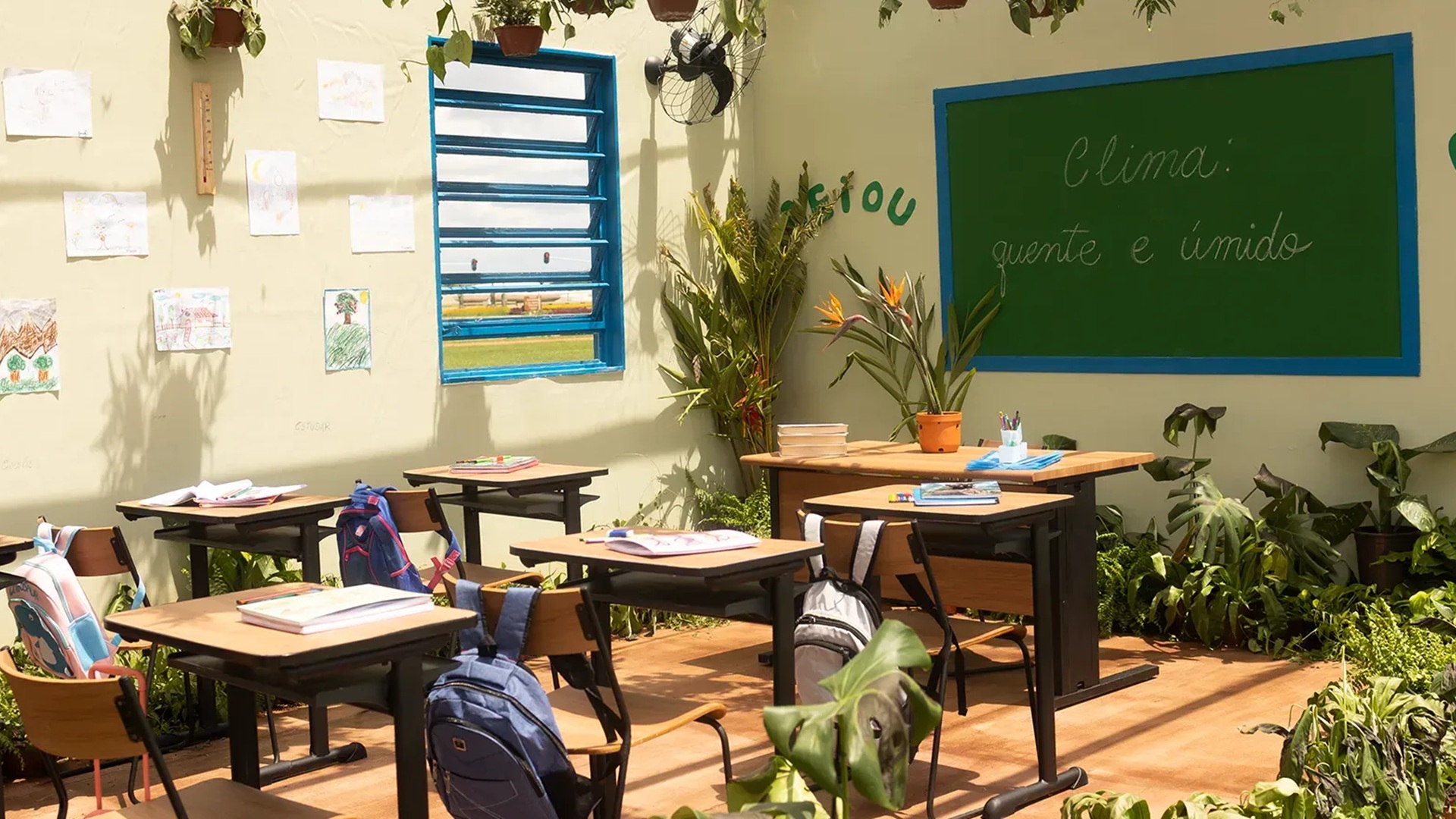
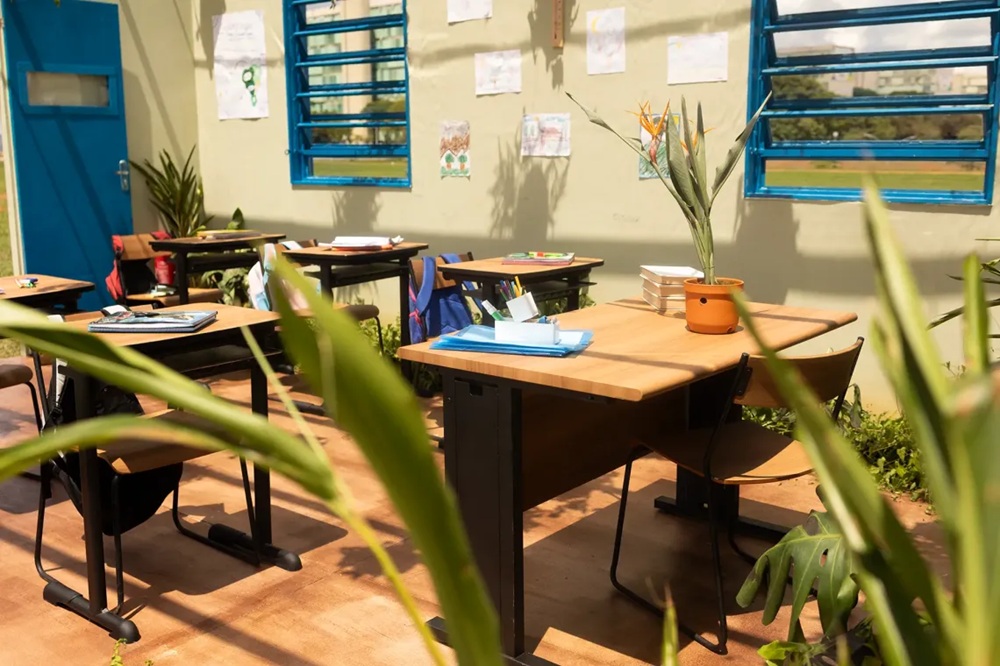
Just in time for COP30, held in Brazil, from 10 to 21 November 2025, the United Nations Children’s Fund (UNICEF) set up an unexpected installation on the Esplanade of Ministries in Brasília: a building that looks like an ordinary classroom filled with plants instead of pupils. This is not a biology lab nor a greenhouse designed for botanical experiments. Resembling a real classroom, where students and teachers would normally engage in educational activities, the structure’s extreme temperatures turned the place into one that is far more suitable for growing plants rather than being a place to study.
Dubbed the “Unlikely Greenhouse” (“A Estufa Improvável” in Portuguese), the installation was created to raise awareness on a very important issue: In many parts of the world, heat waves make it increasingly difficult for students to attend school. According to UNICEF data, a rise in temperatures negatively impacts a pupil’s school performance, with academic results dropping by 1% for every 0.5°C increase.

Conceived by Artplan agency in partnership with production company Genco, the structure is designed to mimic the heat conditions in many classrooms around the world, particularly in low-income countries with tropical climates. Seeking to illustrate the discomfort these kids must endure to have access to education, the 38°C-heated installation targeted leaders, scientists, and civil society attending the event, hopefully inspiring them to recognize the urgency with which climate change must be addressed.
“Children are more vulnerable to climate-related crises, including stronger and more frequent heat waves, storms, droughts, and floods. Excessive heat undermines children’s ability to concentrate and the thermal comfort needed for them and their teachers to engage meaningfully in educational activities. In addition, many cannot get to school if the route is flooded, if rivers run dry, or if schools are destroyed or used as shelters,” explained Mônica Dias Pinto, Head of Education at UNICEF Brazil.
“The ‘Unlikely Greenhouse’ stems from a straightforward question: how can we translate scientific data into an experience that fosters immediate understanding? Instead of relying exclusively on verbal language, we proposed a concrete experience — a classroom that allows people to physically feel the impact of a heat wave. This approach brings the public closer to the issue and supports the development of a debate grounded in evidence and real perception,” continued Pedro Rosas and Pedro Galdi, Creative Directors at Artplan.
Available to be visited only on November 10, children who attended the event were invited to learn more about climate change and the impact it has on daily school life at their schools on 11 November. The project is supported by a short video as well, further explaining the often-overlooked but devastating effects heat waves have on the well-being of millions of students and teachers.
CREDITS
Brand: UNICEF
Agency: Artplan